Eric’s concussion
The Cabin at the End of the WorldEric’s concussion is both a practical disability during the cabin ordeal and a source of uncertainty about what he sees. A previous concussion as a high-school soccer player gives him a history of head injury, but the later injury is more than a recurrence of familiar symptoms: it impairs his memory, intensifies his vulnerability in captivity, and becomes entangled with his conviction that a figure made of light was present during the violence at the cabin. The narrative neither treats his condition as a simple explanation for every perception nor separates it cleanly from the approaching crisis.
Earlier Injury and Return to Play
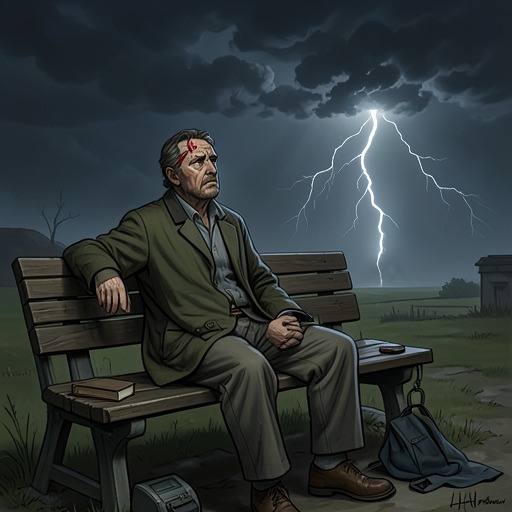
As a high-school striker, Eric was not his team’s most technically skilled player, but his coach valued his fearlessness when challenging for headers. Set plays were arranged to give him a clear run at the ball. In mid-September of his senior season, he collided heads with a defender while both players pursued a ball bending toward the far post. Eric could not remember the forty minutes before the collision. What he retained of the impact was a sharply bounded image of the field, its chalk lines and players, beneath a blue sky marked by bright stars.
Eric missed two weeks of practice and games, then returned before he was ready because he hoped to help his team reach the state tournament. The team did not qualify. For the rest of the season, headers brought on high-pitched ringing in his ears. It gradually faded but never quite disappeared. This earlier injury establishes a pattern of lasting effects after concussion, while also showing Eric pushing himself back into activity before he has recovered.
Injury and Captivity at the Cabin
During the cabin crisis, Eric is left severely concussed after a fall. He cannot remember how he and Andrew came to be tied to chairs, and his recollections of the struggle that preceded it are incomplete. His head pain, sensitivity to light, nausea, and hazy vision make it difficult to orient himself in the cabin. The late-afternoon sun entering through the shattered sliding doors is especially hard to tolerate; even closing his eyes does not fully shield him from it. As clouds cover the sun, his head pressure eases, linking changes in the environment to changes in what he can endure.
His impairment is compounded by the conditions of captivity. Eric’s arms and legs are bound to a kitchen chair, and trying to move his wrists worsens the pressure in his head. Andrew is restrained nearby, but Eric cannot reliably recall whether Andrew was struck or how the two men were secured. He remembers pieces of an earlier plan to get Andrew and Wen to the SUV, including Andrew’s willingness to stay behind, yet he cannot tell what has happened since he lost consciousness. His concern for Andrew persists alongside this confusion: he wonders whether Andrew has surrendered, a possibility that conflicts with Eric’s understanding of the person he loves.
The cabin’s ordinary activity also becomes difficult to bear. Leonard sweeps broken glass, and Wen’s television show plays at a volume Eric has repeatedly asked to have lowered. Leonard initially responds to the requests, then only pretends to adjust the sound. These details make Eric’s symptoms consequential within the scene: he cannot simply retreat from noise or light, and other people control the environment to which his injured head is exposed. Sabrina cleans the wound on the back of his head and covers it with folded paper towels, while describing him as severely concussed but mostly awake. Eric tries to make light of the bandage to Wen, presenting the resulting mark as a resemblance to the scars shared by her and Andrew. Wen does not answer, but moves closer and rests her head against his legs.
Persistent Symptoms and Loss of Control
The next day, Eric is improved but not recovered. His head still feels disordered, the room seems too bright, and fatigue makes it difficult to remain awake. His throat is dry, and he regrets refusing water earlier. Even his position in the chair is exhausting. At the same time, he notices that the ropes have loosened: he can separate his hands and move his lower legs slightly. The small increase in mobility matters because it offers a limited measure of agency, though it does not free him from the chair or the people holding him.
When Leonard prepares to move him, Eric asks not to be dragged because he fears it will worsen his head. He offers to walk if his legs are untied, but Leonard refuses. Sabrina intervenes and suggests carrying him instead, arguing that the group needs him to think clearly. Her action acknowledges the practical effect of the injury even within the captors’ control of his movement. Eric’s condition is thus not merely a private sensation: it influences how others handle him and becomes part of the negotiation over what he can safely do.
The symptoms return with greater force after a second blackout. Eric feels worse than during the first hours after his fall, and his memory again breaks into fragments. He recalls handling rope without feeling it, moving through a haze, and reaching the open doorway, but cannot reconstruct every moment. He remembers fearing that the light would take Wen away if he did not close the door, then remembers Wen beside him as he untied his legs and the sudden realization that she was gone. These memories join the physical effects of concussion to the trauma of loss: his account is neither a continuous record nor a stable basis for deciding what caused the light he experienced.
Perception, Belief, and Uncertainty
The light recurs as both an external threat in Eric’s perception and a question about the reliability of that perception. When Leonard presents the family with another chance to make the demanded sacrifice, Eric is already shaken by the disaster images shown on the news and the sounds accompanying them. The afternoon light further aggravates his condition as he tries to think through the choice. The broadcasts supply concrete evidence of catastrophe, including reports of H7N9 cases in Hong Kong, while his concussion makes the surrounding sights and sounds harder to process. The narrative places those sources of distress together without establishing that the injury accounts for the unfolding disasters.
Later, Eric tells Andrew that he sensed a presence in the cabin around the time Redmond was killed and saw something join the circle around him. He says he tried to explain the experience as a flash of light, a concussion- and stress-induced hallucination, or a migraine, but also says the figure seemed to regard him and that he continued to feel its presence after he stopped seeing it. Eric connects the figure to the later light at the doorway, which he says he tried to keep outside by closing the door. His concussion offers a plausible explanation for some perceptions, but does not settle the matter within the story.
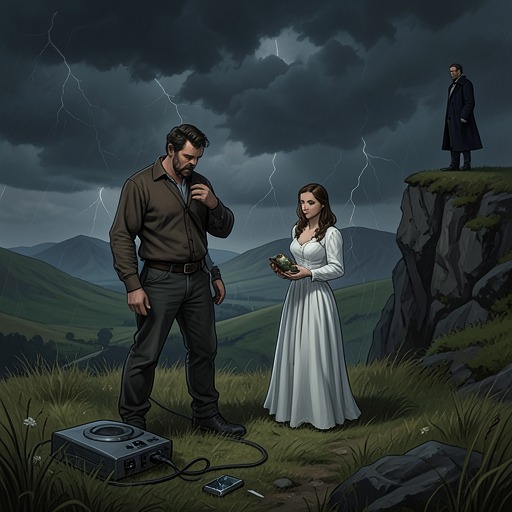
As Eric and Andrew walk after leaving the cabin, Eric acknowledges that he is injured, concussed, and not thinking straight, even as he tries to tell Andrew what he believes may need to be done. During the storm, he perceives the sky as changing through colors that seem impossible to name and the thunder as something other than thunder. Andrew, by contrast, recognizes threatening storm clouds and the signs of approaching rain. Their different accounts foreground the limits imposed by Eric’s condition without making his perception conclusive evidence of either hallucination or supernatural certainty.
Narrative Significance
Eric’s concussion repeatedly narrows his immediate choices: he cannot leave the chair, tolerate the cabin’s conditions, or reliably remember the intervals surrounding his blackouts. Yet the injury does not erase his attachments or his capacity to take part in the family’s decisions. His concern for Andrew, his attempt to comfort Wen, and his later effort to explain the figure all persist through confusion and pain. The earlier soccer injury also prevents the later symptoms from appearing without precedent, while the greater severity and repetition of the cabin episodes mark a consequential change in his condition.
The injury makes uncertainty part of the account rather than a puzzle the narrative simply resolves. Eric’s experiences of light arrive amid demonstrable concussion symptoms and a crisis in which the visitors’ predictions appear to be borne out by news reports. Andrew rejects Eric’s conclusion that the experience proves the figure was real, while still affirming his love and concern for him. The disagreement preserves two simultaneous stakes: taking Eric seriously as a witness to what he experienced, and recognizing that a head injury may shape how he interprets it. His concussion therefore affects not only what he can do, but how the family understands the events they are trying to survive.